
Sending Messages:
Managing the Hidden Curriculum
What do we tell students about what is expected of them by the ways in which we organise and present courses? This is not merely a matter of content, but also of process, and what we do not say may shout louder than what we do.
This paper concerns initial attempts to develop a framework for the study of the hidden curriculum, which might be used to expose it (or them) and to develop tools for further analysis.
This is a paper prepared to accompany a poster presentation at the second conference of the International Society for the Scholarship of Teaching and Learning (Vancouver B.C., 14-16 October 2005); a rather more extensive but less systematic discussion is available to download as an Acrobat file. This version has been up-dated to take account of points made in the poster discussion.
Introduction
Recently, interest in the "hidden curriculum" has been replaced by concern for the "student experience", but there are ideas from past research which repay study. This is not an account of a research project, or a case-study, but a call to use the perspective of the "hidden curriculum" to evaluate our own courses in terms of what students are learning by default, simply by participating in them, rather than what we set out to teach them.
The following paper draws on previous research (some of it old and almost forgotten), and a neglected theoretical perspective derived from an obscure theory of communication and systems to raise questions which may be asked of any course about the messages it sends to the students, and about how they might be influenced to respond, to the enhancement or detriment of their learning.
The idea of the "hidden curriculum"
Hunter (1994), however, argued that such apparently ideological features of schooling were merely necessary by-products of the "social technology" of setting up a school to teach things; just as some of the "conditioning" against which Bowles and Gintis inveighed was not about capitalism, but merely about the requirements of any industrial society. This kind of macro-level of analysis, concerning the permeation of political, economic and cultural factors into the curriculum, has been explored in the States over many years by Michael Apple and in France by Pierre Bourdieu. I'm leaving them out of account�important though their work is�because my interest remains in the impact of practices on the learning experience of the student.
More radically, Illich (1970) had already suggested from the perspective of the developing world that the very idea of "schooling" undermined the value of learning from experience, and moreover that it could never address the issue of education in the third world. Lave and Wenger (1991) similarly maintained that the social technology of education distorted "natural" processes of learning�a point which had been made much earlier, and rather less pretentiously, by Becker (1972).
For our purposes in higher education, therefore, let us set aside most of the above line of debate, and start with Snyder (1971). Snyder's observations pre-figured all the later research on "Deep" and "Surface" learning; he noted that at MIT in the 'fifties and 'sixties, the curriculum was getting more and more crowded as technological knowledge grew, and so undergraduates were taking "short cuts" in their learning. They could not absorb everything, so they strategically tried to guess what would be assessed, for example, and revised only that. Snyder's additional insight, however, was to realise that unintentionally the Institute was teaching them to act strategically, hence the term "hidden curriculum".
Even earlier, Becker, Geer and Hughes (1968) had noted the impact of assessment practices on student strategies:
If ... the instructor announces that an examination will consist of two essay questions, students may reason that the questions will call for broad interpretive answers, rather than detailed factual knowledge. They will then try to analyze the subject matter into a few major points and not bother to memorize details. Conversely, if the instructor announces a multiple-choice examination of 150 questions, students may reason that such an examination must concentrate on detail and thus devote their time to memorization.(Becker, Geer and Hughes, 1968:82)
The same point has been made more recently by Prosser and Trigwell (1999) among others. Becker and colleagues went on to argue that the obsession of students with their Grade Point Average (GPA) was distorting the education task, as Becker put it later:
It is hard to say what the desired outcomes of a college's educational efforts are. But if they are a change in values and the acquisition of certain intellectual skills, students might be diverted from such goals by the necessity of studying for exams not requiring those abilities. When what tests require differs from what the school wants to teach and when the school rewards good test performance heavily the structure of the school will systematically divert student effort. In this sense, and to the degree that these conditions are met, schools are structurally self-defeating. Where students have the opportunity to interact and develop collective conceptions of their situation and how it ought to be handled, they may develop a student culture which amplifies and extends this effect.(Becker, 1972 [1995: 105])
At the same time, John Holt was observing a similar distortion in elementary school pupils' approaches to learning, as they tried to guess what the teacher was thinking and what answer would please her, rather than to come up with their own answers. Such views have been reproduced many times since.
Current thinking often suggests that these issues are the consequences of course design (Biggs, 2003) and the lack of "constructive alignment", and/or of staff orientations to teaching (Prosser and Trigwell, 1999). However, this paper argues that the situation is more complex than that, and goes beyond deep and surface learning strategies.
Moreover, the idea of a single "hidden curriculum" may be something of a misnomer; there are many hidden curricula�perhaps one for each module, or each tutor. There are few straightforward linear courses in universities nowadays; each new module or course and even each contributing lecturer presents students with new challenges, so the "survival curricula" are different.
One Theoretical Perspective
The simple part of the theoretical perspective is that institutions "send messages" to those who participate in them, often unintentionally and covertly. The messages are conveyed and coded in myriad ways, from the quality of the furniture, to the security arrangements, to course regulations, and practically anything else which happens within an institution. Universities are no exception. At a very basic level, this is being recognised in the UK as higher education contemplates the introduction of "top-up" fees; there is a new rhetoric about the student as a discerning consumer, who must be made to feel welcome, with improved student services, better accommodation, and the like. Our marketing staff readily speak of a sending messages to students about how much they are valued.
Clearly, the messages can work in (at the very least) three ways:
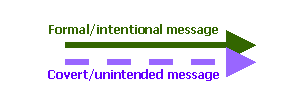 The covert message can reinforce the formal message;this is the consummation devoutly to be wished. So on our journalism course there is no such thing as an extension to a coursework deadline; if you can't get the work in on time you will be no use as a journalist.
It can undermine or negate the formal message; which is problematic in the case of a hidden curriculum. A social work course on which I used to teach , staffed largely by very caring former practitioners, was notorious for arguments about extenuating circumstances for failing students.
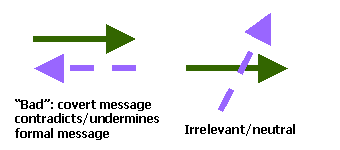
Or of course it may simply be irrelevant;which is of little interest.
Clearly in the real world there are so many of these messages that they are almost inevitably "mixed".
The other theoretical point is a more difficult one, and concerns the nature of such hidden or encoded messages. Since they do not have explicit content, it is up to recipients�in this case, largely students�to make of them what they will. So they follow the rules of what I have called elsewhere on this site "process communication" rather than content communication, renaming in the light of current trends the distinction made by Watzlawick, Bavelas and Jackson in 1967. They referred to "digital" (content) and "analogic" (process) communication.
Three main features of process communication are significant for present purposes:
- As Watzlawick et al. point out, "One cannot not communicate".
- In process terms, the absence of communication is itself a communication. It is the fact that something happens rather than its explicit content which matters. Thus, on one slightly non-standard course, we took great care over the handbook, amounting now to about 150 pages. Yes, it has a lot of content in it, but its initial message to the students is that "no matter how unusual this course may seem to be, the tutors have thought about it and prepared it carefully". It conveys (we hope) a message of security.
- However, since the content of such process messages is only ever implicit, it lies with the recipient to confer meaning on them. So the inferred "meaning" may be extremely variable.
The learning acquired from the hidden curriculum will be referred to as "default learning"; learning acquired by default through sheer participation in the activities of a school or college, rather than what has been directly taught.
It is worth noting that this work owes a great deal to Gregory Bateson. See Harries-Jones (1995)
For my own angle on Content and Process click here
Some instances
All students come to learning with some personal "baggage". Some of that may have been acquired from the hidden curriculum of their schools, and may profoundly "frame" their understanding of their university experience.
Labelling
Perhaps the commonest instance of such default learning is the internalised label, of the "I'm no good at maths" variety. Or of course, more rarely, "I'm God's gift to academe". Each has been acquired through repeated failure, or success, in school. Because university education follows twelve or so years of schooling, it simply inherits such default learning and may not add much to it, but we may be faced with students who are convinced that they are, for example, bound to fail the statistics component of a course in the social sciences. It then becomes important to convey�somehow�the message that "this is not like school".
One teacher in the UK has suggested that the word "fail" should not be used in schools
Of course we get that message over in many different ways in any case. The more amorphous nature of a large institution, the relative anonymity of the faculty, the impersonal nature of the teaching in large lectures, can be a culture shock in itself, but many messages in that part of the hidden curriculum are not helpful, and do not address the labelling which has already taken place.
Challenges
So the university environment is an unfamiliar and challenging one for students, who have to learn how to survive in it. It is often compounded by the shock (and opportunities) of living away from home and parents for the first time. This naturally means that freshers can be both impressionable, and yet keen to hold on to some parts of their baggage; part of that baggage may be the study strategies which have worked to get them this far, although those strategies may not be the best for full engagement with the new discipline of undergraduate study.
Induction programmes may well help at the level of content communication, but this might also be undermined by the way in which, at the process level, they make challenges into "problems". If such programmes are experienced as patronising there can also be a danger of alienating students.
Reinforcement
Again drawing on the school experience, it is commonplace for behavioural psychologists to point out that some disciplinary interventions in the classroom can be counter-productive, because attention (whether positive or negative) is a potent reinforcer for children. However, as teachers point out, poor behaviour cannot be ignored.
Fortunately, higher education does not often suffer from such gross issues of discipline, but there is still the issue of what behaviour gets reinforced.
- Is there encouragement for asking questions or challenging the lecturer? Or is such behaviour met with a put-down?
- Is it safe to venture an opinion in a seminar, or is it treated as naive?
- Does higher-order thinking or originality (however half-baked) really get rewarded in assessments?
- What messages do we send by tolerating, or not tolerating, absence from class?
Note that because of the fragmentation of the faculty�individual academics doing their own thing and in many cases not talking to others about their teaching�and the wide range of options and pick 'n' mix modules which characterise many university courses, students have to work all this out for themselves with each new module they sign up for. The least we can do is to be straightforward and up-front about expectations and how things work in this class. They may not believe us, but it's bound to be better than leaving them floundering and wasting precious time and intellectual energy trying to suss out what we want.
Trust and security
Trust�and the lack of it�is the clearest exemplar of process communication. And so the question of whether students trust us, and whether we trust students, is a critical component of the hidden curriculum.
- Testing for plagiarism is a necessity nowadays; but what messages does it send to students?
- We may want to offer students more choice in how they study; but does it merely leave them bewildered?
My own research on a course for mature students on andragogic principles indicated that what initially intended as a humanistic programme offering a high degree of student freedom came across as confusing and even inhibiting. Students indicated that the more secure they felt, the greater they felt able to take risks.
My own paper on this is available (slightly amended) as a download here
Conclusion
There isn't one. There is no point in drawing substantive conclusions from case-studies and action research. All that can be offered is an often-neglected perspective, asking what it is that we teach unintentionally, and how by adopting this perspective we may seek to reinforce valuable process messages and diminish the others.
References
ATHERTON J S (2000) "Containment and Adult Learning: theory and practice" Socio-Analysis Vol 2, No 1, pp.28-46
BECKER H S (1972) �School is a Lousy Place to Learn Anything In� American Behavioral Scientist 1972 pp 85-105, also in Burgess (ed.) (1995) q.v.
BECKER H S, GEER B, and HUGHES E C (1968) Making the Grade: the academic side of college life New York; John Wiley
BIGGS, J (2003) Teaching for Quality Learning at University (2nd edn.) Buckingham; Open University Press: SRHE
BOWLES S and GINTIS H (1976) Schooling in Capitalist America London: Routledge and Kegan Paul
BURGESS R G (ed.) (1995) Howard Becker on Education Buckingham, Open University Press
HARRIES-JONES P (1995) A Recursive Vision; ecological understanding and Gregory Bateson Toronto; University of Toronto Press
HOLT J (1970) How Children Fail Harmondsworth: Penguin
HUNTER I (1994) Rethinking the School: subjectivity, bureaucracy, criticism London; Alan and Unwin
ILLICH I (1970) De-Schooling Society Harmondsworth: Penguin
LAVE J and WENGER E (1991) Situated Learning: legitimate peripheral participation Cambridge: Cambridge University Press
PROSSER M and TRIGWELL K (1999) Understanding Learning and Teaching; the experience in higher education Buckingham; Open University Press: SRHE
SNYDER B R (1971) The Hidden Curriculum New York; Alfred A Knopf
WATZLAWICK P, BAVELAS J B and JACKSON D (1967) The Pragmatics of Human Communication New York: W W Norton
Atherton J S (2013) Doceo; [On-line: UK] retrieved from
Original
material by James Atherton: last up-dated overall 10 February 2013 
This work is licensed under a Creative Commons Attribution-Noncommercial-No Derivative Works 3.0 Unported License.
Search Doceo and associated sites:
 Save this on Delicious Tweet
 Click
here to send to a friend
Click
here to send to a friend
This site is independent and self-funded. The site does not accept advertising or sponsorship (apart from what I am lumbered with on the reports from the site Search facility above), and invitations/proposals/demands will be ignored, as will SEO spam. I am not responsible for the content of any external links; any endorsement is on the basis only of my quixotic judgement. Suggestions for new pages and corrections of errors or reasonable disagreements are of course always welcome.