
Knowing and Not Knowing
I think I know
If I don't know I know
I think I don't know
Laing R D (1970) Knots Harmondsworth; Penguin (p.55)
"He that knows not,
and knows not that he knows not
is a fool.
Shun him
He that knows not,
and knows that he knows not
is a pupil.
Teach him.
He that knows,
and knows not that he knows
is asleep
Wake him.
He that knows,
and knows that he knows
is a teacher.
Follow him."
(Arabic proverb)
NEIGHBOUR R (1992) The Inner Apprentice London; Kluwer Academic Publishers. p.xvii
Donald Rumsfeld (4 Sept 2002) (Woodward, 2004: 171. Video here.) It is ironic, perhaps, that the initial insight is allegedly Arabic.
This paper is playing around with a conceit: two senses of the term "know". However, it is all in a professional cause.
The two senses are those of:
- awareness of self, (represented by the vertical red line in the diagram below) and
- knowledge of the world (the horizontal blue line)

There are of course four possible combinations, which are explored below. "Knowledge" but not simply as Bloom understands it: potentially this is the whole cognitive domainYou may find parallels with the witting and willing practice model, and also with the familiar "unconscious incompetence" to "unconscious competence" model, which relates primarily to practical skills: here we are exploring knowledge. Laing's poetic exploration of its interpersonal convolutions cited above (it goes on for another 21 pages), and the citation of the idea by Neighbour (1992) credited as an Arabic proverb demonstrate that it has a considerable provenance.

Not knowing you don't know
The first possibility is that of being unaware that you don't know something. This is the "ignorance is bliss" state, enjoyed by everyone who pontificates about politics in pubs. It is also the position of many people on "soft" occupations (such as teaching, or social work) which look from the outside as if "any fool could do it". (Some do.) And it is engendered by consummate professionals who make what they do look easy (such as plasterers and chefs and popular novelists and...).
Many students start from this position, and although the Neighbour proverb calls them "fools", it is not really fair. Let's go on �

So the first move is often to make learners aware of their ignorance. This is tricky, in practice. Unless they are a captive audience it is quite easy to frighten them off. (It is also quite seductive, because it is a chance to show off your own level of knowledge or competence.) On the other hand, it is a crucial step in developing motivation to learn.
There are various ways of doing it.
- The German teacher's name was Roger Baker (in the unlikely event that he wants to look himself up on the web)In my first German lesson, a young teacher recited a poem to us in German: it sounded great, but we couldn't understand a word of it, of course. He didn't really need to do it, because we already knew we didn't know any of it apart from a couple of phrases picked up from war films. He was trying to show what we might aspire to, and went on to explain that. (It must have made an impact because I can remember the lesson fifty years later.)
- You can ask a student (usually either one who is a bit full of himself and needs to be "taken down a peg", or one who is mature enough not to be humiliated) to do something practical in the certainty that he will fail. Only do this if you are confident that when you do it, as you will be challenged to, you can manage it yourself.
- You can pose a problem which has a seemingly simple answer (political, economic, legal�or in Neighbour's case, medical), and then show the problems in reaching that simple solution, which stem from ignorance of the context.
The trick is to show something which is (so far) beyond the students' reach, but not so far beyond it that they will despair. The second trick is to make it interesting. I have deliberately not mentioned strategies for doing this in accountancy.
More significantly:
- In continuing professional development courses in particular, you may be challenging survival-oriented practice in which people have a substantial vested interest: this is the key to the whole un-learning/learning process. See Learning as Loss for more on this.
- Unless you have to do it, don't. Many learners (particularly those who have signed up for your course of their own free will) are only too aware of what they don't know. The last thing they need is for you to rub it in.
- Skill in this area is of course a core competence for charlatans. Whether self-help gurus who must convince you of your personal inadequacy or potential ill-health, religious proselytisers who must convict you of sins only they believe are sinful, or salespeople who have to create a "need" for their product, they all have to manage this stage. Study and learn from them�just don't believe them.
- A specialist variation on this is �the anosognosia of everyday life� as Dunning (2005) calls it. See here for a great article on that, which is more relevant to teaching than one might at first think.
Knowing you don't know

This move, from "knowing that you don't know" to "knowing that you know" is what most learning and hence teaching is all about.

Knowing and not knowing that you know
The interaction between knowing and not knowing that you know is however more complex and much neglected.
There are two kinds of knowledge (in a third sense) or practice involved here.
- The first is that for which the move to "not knowing that you know" or "unconscious competence" is the highest stage of development. See the Learning Curve page. This applies to the basic skills of driving, or knitting; the kind of thing you can "do without thinking".
- The second is where people who have informally learned a great deal mistakenly put themelves in the "knowing that they don't know" category because they have never received any academic or professional accreditation for their learning. This is the downside of our qualification-driven culture, which dismisses those whom Gramsci called "organic intellectuals" because they do not have the recognition of the formal educational system.
In the UK, the system of National Vocational Qualifications (NVQs) and their Scottish equivalents was designed in the late 1980s to provide an assessment scheme to grant credit for just such unsung competence: in the event, it has become just another training scheme. (Discuss!)
The situation of such learners is like that of M. Jourdain in Moli�re's Bourgeois Gentilhomme who was delighted to discover that he had been speaking prose all his life. A major task for the teacher of adults�particularly perhaps the "basic skills" teacher and the teacher on access programmes�is to enable learners to claim credit for what they already know and can do, without ever having realised that it is "worth anything".
Neighbour's Arabic proverb enjoins us to "awaken" someone in this position, which means to take them back, counter-clockwise on the diagram, to an awareness of their knowledge. There is a link here with Mezirow's concept of "transformative learning", in which education leads to a re-evaluation of life so far.
- (There is perhaps a third possibility here, too, which is the fit with the willing but unwitting category in the model of practice on this site.)
The problematic expert
The fourth possibility is touched on in the discussion of expertise. This the person who (wait for it!) knows that she knows but does not know how she knows�or cannot express it. Ask about a particularly brilliant bit of practice and you will get a banal answer which might have come out of the textbook, but which totally fails to do justice to the complexity of what she has done. Sometimes that answer will be given because she does not want to appear a "smart-arse" ("Ass" if you are American, but I wouldn't wish to confuse you with references to donkeys.) Sometimes, though, she might claim that it is a matter of "not being able to put it into words" or even, disconcertingly, of a "hunch".
She may even be afraid of trying to express her expertise, for fear that an inadequate exposition will somehow jeopardise fragile knowledge. Once she has said it, it might become ossified. She might feel obliged to live up to her exposition and limit that insight and creativity which goes beyond words.
I was once asked to contribute to a cookbook. I have a few recipes which I am quite proud of, and I decided to offer one which involved making a batter. I had to systematise the recipe, and specify quantities: but I just could not get it right. Left to myself, as it were, I could just slurp in the milk and get the right consistency with no problem. I was probably taking account of the size of the egg and several other variables�but for the life of me I could not specify the quantity of milk. I had the same problem with the herbs in another recipe. I gave up. Interestingly, it was several weeks before I was able to make those recipes again with the same insouciance I had previously taken for granted.
Some things we can teach, and some we can't.
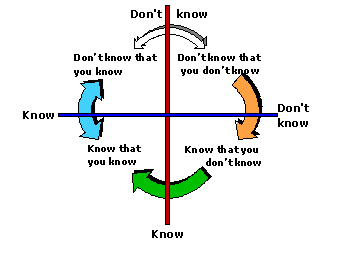
So that's the whole story. Or is it? Is there any connection between the "Don't know that you know" stage and the "Don't know that you don't know" stage? Possibly (but not always).
- There may occasionally be a cycle: if you don't know what you do know, you probably don't know what you don't know, either. This may be the case for people who are stuck at a survival learning level. They have learned to get by with what they know, to the extent that they do not give themselves credit for it, or are even unaware of knowing it, as we have discussed. However, they can't take it any further because it is out of awareness, so they are unaware of how they could move on from mere competence or proficiency to real expertise.
For such people, because they do not know what they know, they may be unsure of their knowledge, and may be threatened by the prospect of moving on, which leads to a degree of resistance to new learning.
The Bottom Line
Clearly we have to get people to realise what they don't know, if necessary. But fascinating though it is, the inarticulate expertise of not knowing that you know is a dead end from the learning and teaching point of view. The only open position, with potential for development, is that of knowing what you know.
Notes:
"Unconscious incompetence" etc.
Most readings seem to accept this model as a given: it is most frequently cited as an idea from Neuro-Linguistic Programming. The following sites explore it without provenance:
- http://www.trainer.org.uk/members/theory/ process/stages_of_learning.htm
- http://www.neurosemantics.com/Articles/ Unconscious.htm
- http://www.nlp.org/glossary.html#U
The following sources have been cited as its origin, although I have not so far been able to get hold of them to check them out:
- Dubin, P (1962) 'Human Relations in Administration', Englewood Cliffs, NJ, Prentice-Hall
- Kirkpatrick, D. L. (1971). A practical guide for supervisory training and development. Reading, MA: Addison-Wesley Publishing Co.
- There's a fascinating exploration of the whole story at http://www.businessballs.com/consciouscompetencelearningmodel.htm

Ignorance Map
The medical school at the University of Arizona has taken similar ideas further with their Curriculum on Medical Ignorance (CMI) and developed the Q-Cubed; Questions, questioning and questioners project. Here is their "Ignorance Map", which identifies:
- Known Unknowns: all the things you know you don't know.
- Unknown Unknowns: all the things you don't know you don't know
- Errors: all the things you think you know but don't
- Unknown Knowns: all the things you don't know you know
- Taboos: dangerous, polluting or forbidden knowledge
- Denials: all the things too painful to know, so you don't
�as you see, it goes rather beyond my little model.
[acknowledgements to Perkins D (2009) Making Learning Whole: how seven principles of teaching can transform education San Francisco; Jossey Bass p 241 for the link.]
Language
Many thanks to Dan A Wilson, a retired professor of linguistics, who emailed to point out that the greatest body of material that we don't know that we know is the language we use so proficiently:
"Much of what we know,
we know we know. Much of what we don't know we know we don't know. Less
obvious to most people is that there are things we don't know that we
don't know we don't know (laughter followed Rumsfeld's reference to that
important category). Least obvious to most people is that there are
things we know that we don't know we know.
Linguistics is about the
last: the language systems we have mastered, usually as small children.
People are generally completely unaware of the complex sets of rules,
components, features, and interrelationships they came to know when they
acquired a language. The complexity of any human language is, in fact,
so great that no human, let alone a mere toddler, could learn one (and
many learn more than one), if it were not for the hard-wired templates
for language in human brains; templates that don't exist at all in the
other animals; templates that let a child acquire the language of any
community she is born into, without overt instruction in the system of
that language, and without even any any conscious notion that there IS
such a system to be acquired."
(4 July 2013)
Ref: WOODWARD B (2004) Plan of Attack New York; Simon and Schuster [Back]
(updated 8 July 2013)
Atherton J S (2013) Doceo; [On-line: UK] retrieved from
Original
material by James Atherton: last up-dated overall 10 February 2013 
This work is licensed under a Creative Commons Attribution-Noncommercial-No Derivative Works 3.0 Unported License.
Search Doceo and associated sites:
 Save this on Delicious Tweet
 Click
here to send to a friend
Click
here to send to a friend
This site is independent and self-funded. The site does not accept advertising or sponsorship (apart from what I am lumbered with on the reports from the site Search facility above), and invitations/proposals/demands will be ignored, as will SEO spam. I am not responsible for the content of any external links; any endorsement is on the basis only of my quixotic judgement. Suggestions for new pages and corrections of errors or reasonable disagreements are of course always welcome.